.png)

.svg)
.svg)
.svg)
.png)


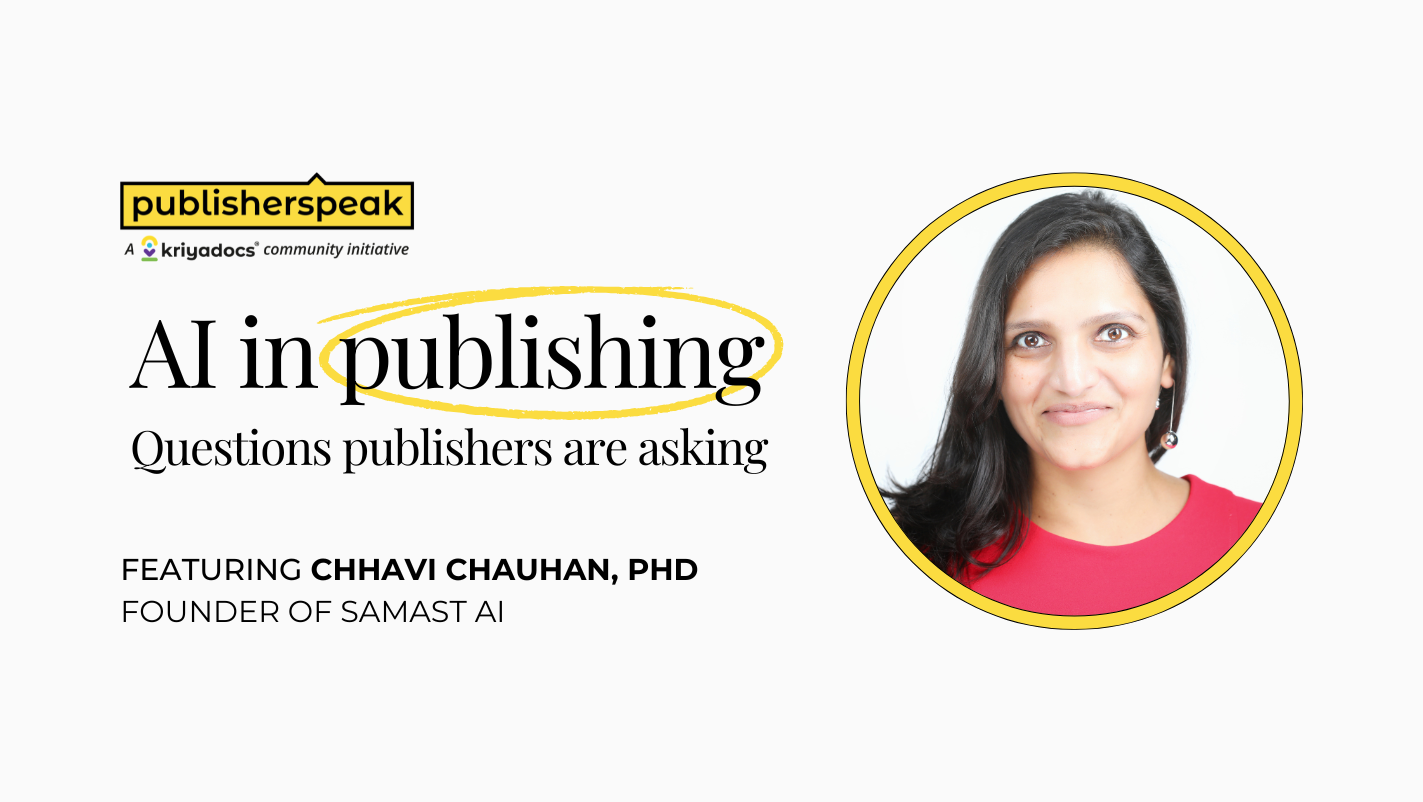


At Publisherspeak US 2025, a panel discussed how publishers are dealing with the fast-paced changes that artificial intelligence is bringing to scholarly publishing.
The panel, titled “A Practical Guide to Managing an Evolving AI Landscape: Collaboration, Provenance, and Practice!”, explored questions about responsibility, transparency, and how AI is used in publishing.
Chhavi Chauhan, PhD, founder and President of Samast AI, led the discussion. The panelists were Tim Lloyd (Founder and CEO, LibLynx), Wendy Queen (Chief Transformation Officer, Johns Hopkins University Press), and Gary Price (Curator/Editor, Library Journal’s infoDOCKET).
Attendees of the Publisherspeak US 2025 conference sent in thought-provoking questions for the panel. In this blog, we are joined by Chhavi Chauhan, who shares her responses to those questions.
1. “If responsible use of AI in publishing results in fewer accepted papers due to better filtering of low-quality or redundant work, how can publishers reconcile this with business models that rely on content volume and revenue growth? Could less be ok?”
Chhavi: I strongly believe that we are shifting from readers valuing content in a particular shape or form to newer smaller reliable and trustworthy knowledge sources. We are bound to move away from the concept full form manuscripts to knowledge capsules and hence, whether we like it or not, whether we are prepared or not, the business models around us will evolve. We would be in a better position if we dictate both the token of knowledge dissemination as well as the business models that would work in our favor. And, yes, less would certainly be more desirable than barely usable or relevant long-form content.
2. “Authors are increasingly required to disclose AI use in manuscript preparation—should publishers be held to similar standards by publicly disclosing what AI tools they use in editorial workflows such as peer review, copyediting, or desk rejections?”
Chhavi: Absolutely. The foundation of scholarly publishing relies on trust and transparency. By staying transparent, the societies and publishers need to lead by example by earning the author's trust back. I have confronted so many instances in our industry when the authors felt cheated as they accused the publishers of leveraging AI without full disclosure or without having a clear and defined AI policy. However, as the use of AI becomes more ingrained in our industry, these disclosures and policies will shift and perhaps become unnecessary in some instances, as we are already seeing it.
3. “Could AI be used to shift the narrative around retractions—from one of failure to one of progress and correction?”
Chhavi: I believe that in today’s shifting landscape where it is difficult to keep up with the pace of advancement, it makes most sense to have access to all and also importantly the latest version of record for any knowledge source (what is traditionally considered a manuscript). As knowledge shifts in the light of new information, the credibility of research or any published scientific claims may shift as well. We should seriously consider using AI to improve, to progress, and course correct, instead of as a tool to penalize folks for an intentional or unintentional oversight that may unnecessarily jeopardise their professional careers.
4. “Are the AI-related risks and benefits significantly different for HSS compared to STEM fields, and how might that influence infrastructure and policy decisions?”
Chhavi: I am the most familiar with STEM journals and within my limited capacity I believe that HSS may face even bigger challenges as the advancement in HSS may largely rely on historic data that AI can leverage more effectively than rather novel and recent scientific data that may not be a part of the training datasets yet. However, I strongly believe that AI is not there yet and I doubt it would be in at least my lifetime to add meaningful depth to HSS research to make such research obsolete.
5. “How should safeguards and guidelines distinguish between or be different for different kinds of AI (e.g., generative, analytical)?”
Chhavi: We are still far from putting in place simple AI policies to address this question adequately. We may continue to lean into our bigger industry partners (like Wiley, Springer/Nature) to recommend a framework as they themselves start leveraging specific AI tools and technologies in their workflows. I wouldn’t be surprised if big tech rolls out new products without guardrails to assist our industry in ways we have not envisioned yet either. I guess we will have to wait and see how it all plays out. Too much is happening too quickly now.
6. “How can the publishing ecosystem best employ AI technologies to improve the accessibility (i.e., WCAG conformance) of content, platforms, and distribution chain.”
Chhavi: I believe the movement is already happening, and the process will become more robust, reliable, and mainstream in the months to come. At a recent conference, several industry partners shared success stories of experiments as well showcased reliable tools they have rolled out that conform to the WCAG standards. There was open support for one specific vendor from a couple of users and accessibility experts in the audience. So, the movement has indeed started.
Conclusion
These questions from the audience show what publishers are thinking about as AI becomes a bigger part of research and publishing. Areas of concern include quality control, responsibility, accessibility, and how different fields within the publishing industry are affected.
As Chhavi's answers show, tools are evolving, business models are shifting, and the community is making choices, fast. What comes through clearly in her responses is that those who engage proactively, with transparency and intention, will be better positioned to shape what comes next.
We thank the Publisherspeak community for their thoughtful questions and Chhavi for sharing her perspectives!
Registrations for Publisherspeak US 2026 are now open and free for publishers. Find out more and secure your spot here.