.png)

.svg)
.svg)
.svg)
.png)




About The Publisherspeak Podcast
Real stories. Honest reflections. Conversations about leadership, change, and the work that shapes our world.
Hosted by Sowmya Mahadevan, Chief Orchestrator at Kriyadocs, The Publisherspeak Podcast features interviews with people making meaningful moves—inside and outside the world of scholarly publishing. From academic leaders and publishing professionals to coaches and change-makers, each episode goes beyond job titles to explore personal journeys and the mindsets behind impactful work.
In this episode
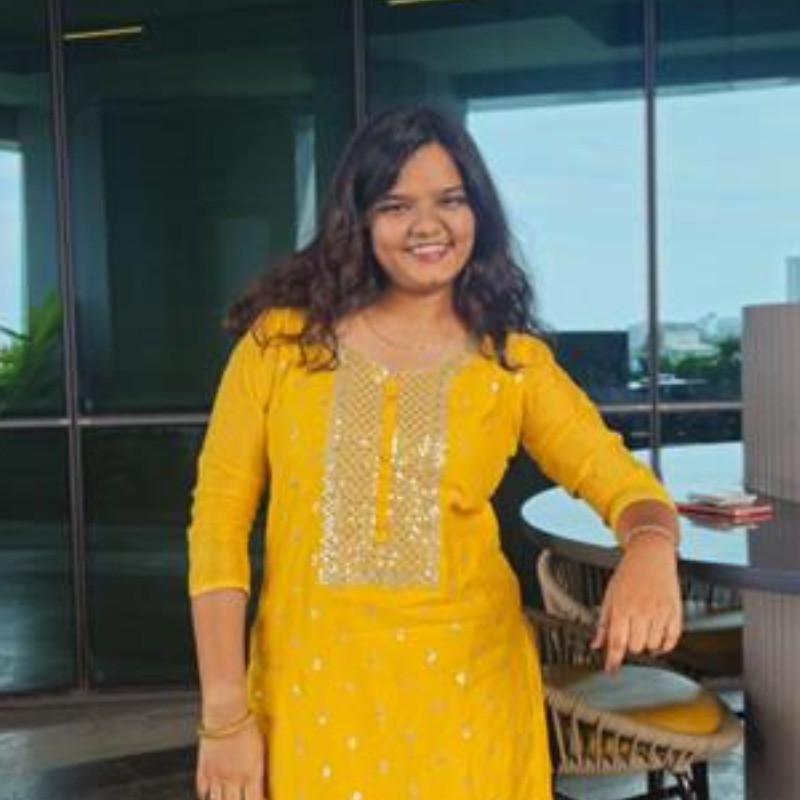
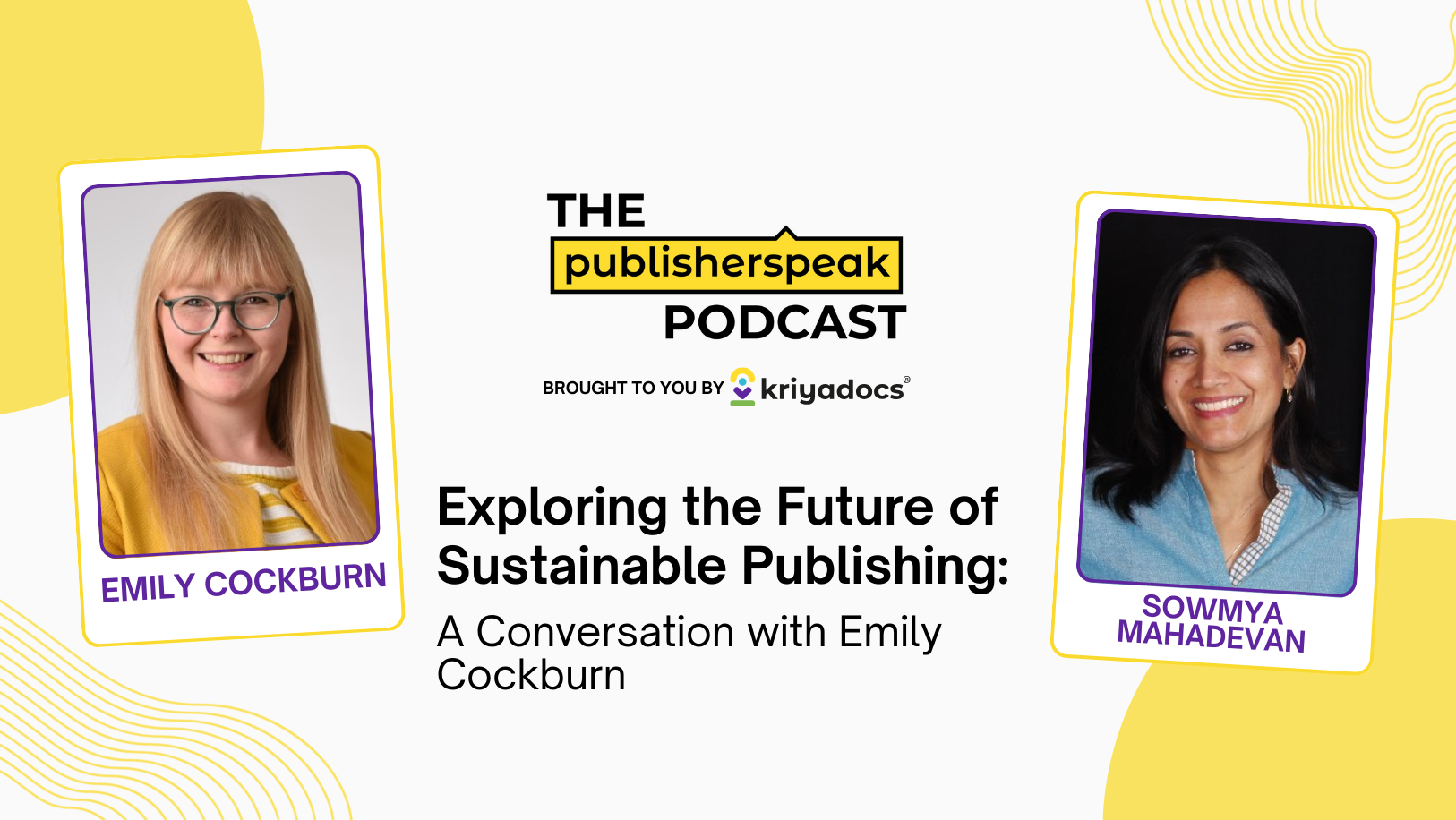
Host Sowmya Mahadevan sits down with Emily Cockburn from Cambridge University Press & Assessment to explore what sustainability really means in the context of modern scholarly publishing.
Drawing on her experience across operations and sustainability, Emily shares how publishing teams can build resilient, future-ready workflows while staying focused on clarity, trust, and long-term impact. From adapting to industry change to embedding sustainability into everyday decision-making, this conversation offers practical insights for publishers navigating what comes next.
Dive into the full conversation below or watch the episode here.
Full conversation
Sowmya: Hey Emily, it's wonderful to have you here on The Publisherspeak Podcast. I know you're really busy but thank you so much for taking the time to speak with us today.
Emily: No problem, Sowmya. It's lovely to speak with you and yeah, share some insights from my time in publishing.
Sowmya: Superb. So, one of the first things that I like to ask all of my guests is how did you get into the world of publishing? I mean, is that something when you were at college you said, oh, this is what I want to do, I want to get into publishing. Or did it happen by accident? Or what's your story, Emily?
Emily: No, it was very intentional. I was one of these people who was doing a humanities degree, Classics in my case. And you know, you start thinking about your career options and my family background. Actually, no one had gone to university before me, so they were all sort of asking, and what job will you have? What job will come from this thing that you are doing? So, it was very clear to me that I needed to secure a career out of my degree. So, I thought about the options and thought publishing would absolutely suit me and did some internship, found some connections and actually started my first job with Oxford University Press before I'd officially graduated because I was so fixed on making sure, I'd got myself a role there.
So, I joined their Journals production team and the journey's gone from there because operations was Absolutely the right place for me to land. I'm by nature a doer. And in that interview, they asked me the classic operations question, what's most important? Time, cost, or quality? And because it was my first proper job interview, I just said time and then didn't say anything else because I hadn't thought about how to answer that question properly.
And they said, could you tell me why? But I think that instinctive response is what's so telling there. You know, I was an operations person from the get go and I do have done a few other things in my career in publishing, been in editorial. I've been in a role that ended up being a bit of everything. But, yeah, I found my homeland in publishing operations.
Sowmya: That's fabulous. I don't think many people don't come out of college saying, I want to get into publishing. I mean, you're one of those people who had that drive to come into the world of publishing, and you realize that was your calling. But you've also been very inspired to focus your career within publishing on sustainability and operations. I think these are your sort of what your passion speaks to. So, what prompted you to get it? I get that operations, you said you are a doer. What also motivated you to look into sustainability as a career focus?
Emily: Well, I think it's a necessity, isn't it? It's a big word. And it's not just sustainability in terms of environment, though I do care a lot about that. Sustainability is how we operate as a business, and how our economy works. If you look at the Sustainable Development Goals from the United Nations, there's so much more to it than the environment.
But as I say, I do care a lot about that and I think having my children, my second child's turning one in Aug, they bring that out in me that care for their future. I have an awful lot more plastic nonsense in my house than I used to. But aside from that, you know, I'm thinking about the future world they'll grow up in, more having had them. So, when I came back after my first child, I actually took the opportunity to study a course with Cambridge Institute of Sustainability Leadership, their Net zero short course. And it sort of simultaneously shows you that the big picture is very overwhelming.
But actually, I left the course feeling very optimistic because everything they convey is that Net zero is a win for business if you do it right and that's if you make it a priority, then it ends up being a win win. So, all of that interest around circular economy and yeah, it feels sort of like a no brainer to me. We should all care, we should all be making an effort. It should be a priority in the same way as operations. Just felt like my homeland.
Publishing almost now for me is. It's just the place I happen to do that, you know, it's the place I happen to care about both of those things but a great place to care about them.
Sowmya: Sometimes it's just common sense to think about sustainability, isn't it? I mean no other way about it but as your role at Cambridge University Press evolved and how is it, what do you do today and how did. How has it grown over the years? What are you responsible for at Cambridge University Press today?
Emily: Yeah, I've been there for eight years now. Time flies. I support content delivery for Cambridge University Press. That's all of our academic research publishing, all of our books, our journals, our elements, which is a short form of book that we do for the academic market.
So that's our university and professional level publishing. So that's what my teams are making. Initially I just looked after the pre-press side, so I suppose from final sign off of files to final delivery of the final content files. But I took on the supply chain responsibility in 2021 and started working with our physical products as then as well of course the digital distribution of our products too to end customers. And I think we do obviously need to think about digital impact when it comes to sustainability as well.
Cambridge does amazing work in that space but equally the biggest impact in terms of carbon reduction is still going to be through paper and freight and changes that we can make there. So, I think the roles evolved in that I think about those things an awful lot more obviously now than I did. But really thinking about the end-to-end life cycle of our content is really important.
Sowmya: Well absolutely. And with your focus on being a very operations driven person but also being governed by the values of sustainability and the longer term future, how do you kind of like. So, one is more practical, right? You do need to do like you said, save time, save money and make sure that there is high quality. But how do you also bring in this value of sustainability, transparency, the impact that we make on the environment. You almost have to mesh short term deliverables and long term values in here. Has it been easier for you that you also have control over the operational aspect of the business? How have you been able to marry these two things?
Emily: Well like I said, I think that course and if you really think about it properly you're going to have a win win situation when you're aiming to do the right thing for the planet. Or at least you can find ways to make that the case. So, a major change we're seeing in our book publishing particularly is a shift towards increasing our print on demand. And I spoke about this at London Book Fair 2024 Academic Cambridge University Press is trying to reduce its carbon emissions in scope three by a third by the end of 2027.
And we're really achieving that by moving many more of our books to printing on demand as opposed to conventionally printing, storing that in a warehouse, shipping it to lots of different places. We have so much more flexibility and can reach our customers more quickly. And of course we do save costs because we're not spending on that warehousing and distribution in the same way. We're not there yet. We've not absolutely nailed every part of that process and got it exactly how we want it to be.
But we're seeing the impact improve for our carbon impact and our costs and how we work. But to your point about the end to end life cycle, there are obviously changes we can make to the content and the way we put that together to facilitate that. So, if you know that you're really going to try and aim for print on demand for a high proportion of your publishing, then there are certain specifications and things that are just less easy to support in that printing methodology. That doesn't mean you can't make a beautiful book, you're just making a different beautiful book. So really planning ahead or if it's about the quality of the images in a different printing methodology, you can make sure you've prepared those images appropriately with your pre press suppliers so that they're going to appear correctly in print and that that won't have an impact on the digital output as well. So, I think that end-to-end thinking is really critical to driving success in thinking about sustainability and how you work.
Sowmya: Yeah, and it's also about driving all of these small changes end to end. Like what you're talking about. It is looking at the bigger picture, but also being focused on thinking about some of these changes which might look like operationally you are changing from how you used to work. But from what I'm hearing from you is in the long run you actually derive operational benefits as well.
So, you've said that your costs went down. I mean, that's phenomenal to hear. And there's always that advantage of stepping back, looking at your operations with a different lens, then trying to drive changes through that as well.
Emily: Like I said before, it's a necessity. It's not like where we're operating in the United Kingdom, we have those net zero goals for 2050.
I think Cambridge, we've decided to aim for 2048 for net zero. That's for Scopes 1 and 2 rather than 3, which just to get into the jargon for a moment, is the impacts. 1 and 2 are the impacts you have yourself as an organization. Scope 3 being the ones that are through the people you work with, sort of one step removed. But those goals are really important.
They're not just targets for no reason. We need to make these changes to try and reduce the change on our climate and the impacts there. So, if you take that as a given and then try and find a way that you can work, that also provides you with other benefits. That's what I mean by that kind of win, win situation. You know, you need to do that. So how can you operate now to try and achieve that goal later?
Sowmya: No, absolutely. I think that's a very valid point. Now, Cambridge also has a very strong focus on listening to your authors. I think this is something that you pride yourselves on.
Emily: Absolutely.
Sowmya: Your view, and this is one of the topics that came up as well in the Publisherspeak UK this year. What do you think authors are looking for from publishers? And you know, do you think publishers are meeting those sorts of author demands or have a good understanding of what the authors require? What is your take on authority, author experience and what do they look for from publishers?
Emily: I think, you know, the thing is it can still really vary across disciplines and Cambridge is a fantastic publisher in that we have such a breadth of what we publish. We do publish STM content, we publish a huge amount of humanities and social sciences content. And of course, the author expectations and preferences vary across those disciplines. Whereas perhaps publishers who have got a more targeted focus can therefore target their approach more. Whereas we want to try and offer a high level of service to a variety of authors and customers.
So, we do that by making sure we're listening and we're talking to them and we are hearing the feedback. We do surveys on publication to make sure we're giving people an opportunity to come back. I'm sure that's pretty standard industry practice but obviously going through all of that feedback and listening as we go as well, while we're working with those authors at all stages of the process. And the things I think that stand out thematically, whatever background the author comes from, is that they'd like clarity. So, whether that's what the deadline is when they're expecting to publish what we need them to do.
You know, making sure instructions are straightforward, that the tools we're working with are appropriate for them and their content. Of course, they also want quality. And at Cambridge, we've got very high standards for that. We really want to work to uphold those. Something I really pride my team on is we have a team of internal quality experts who are ensuring all of our style guides are correct.
We have our practices for copy editing and indexing and proofing meet expectations, and their previous copy editors themselves in general, that's the background they come from. So, wherever challenges do arise, we also have that dedicated expert team to help us resolve issues that do come up. We've also put a lot of effort recently into setting ourselves up to meet the requirements for the European Accessibility Act. And there's another potentially win, win scenario. One in five people are affected by something that act is seeking to serve.
So, 20% of potential customers are benefiting by us making changes in line with that legislation. That doesn't make it any easier to necessarily do to the timelines that were given. And, and obviously there's more coming with the American for Disability act and clarity coming on that in the next coming months. But it's a lot of effort, but for absolutely the right reasons. And I think that's another place where I appreciate sustainability more broadly, as we've said.
Sowmya: Absolutely. So, one of the things that we hear about within the publishing organizations is that sometimes we are very slow to change in this industry. Right. So, it's more legacy, more traditional. But then there's a lot of these emerging trends that keep coming in. And now, I think, not just within the industry as a world, every industry is forced to adapt and change and make changes faster and things like that. Is there anything you're doing at heading operations at Cambridge University Press? Is there anything that you're doing to prepare the organization to adapt to these sorts of trends? And generally, the way as an industry, we adapt to changes.
Emily: Yeah, it's a real challenge, isn't it? Because nothing is ever one size fits all in publishing. And as I've mentioned already, Cambridge's list crosses huge amounts of disciplines, different authors, different requirements, and we aim to cater to that as far as we can. And of course, the other point is that emerging trends are emerging, so we don't know what they are. So, it is a challenging situation.
It really comes down, therefore, to your people and your change readiness, because you can as a company, you know, Cambridge might choose to respond slightly differently to an emerging trend to another publisher, or that might be the better approach for our authors versus their authors. But either way, you still got to have the people that you work with, the people in your teams ready and open to that change, knowing they're resilient, that they can handle the frequency of change that we have at the moment and the complexity of that change. So, I really try and put a lot of thought and support into my teams in that regard. You know, making sure that training budgets are spent. One of the famous things in all businesses, I'm sure, is that no one ever spends that whole training budget, right?
So, making sure people are actually taking those opportunities to, to make sure they are ready for the situations we are all dealing with at the moment.
Sowmya: So that's actually a very interesting point that you make there. You know, getting the people ready through via training, more structured training programs and things like that is one way probably to make sure that your team is able to adapt to the change that is coming, and that resistance is not there.
So, I think that's a very valuable takeaway for me as well. Now, you at Publisherspeak, you chaired the session on sustainability, right? And I think you did a really, really good job. But for our listeners, I do want you to talk a little bit about more in detail about what you have done at Cambridge University Press, or what are some of the guidelines or advice, so to speak, that you can give to other publishers who also have similar sustainability goals.
Emily: I mean, like I said, I hope we all have those goals. You know, I'm really pleased that we're making it such a priority at Cambridge, but this is a necessity for all of us to deal with. It's called a climate crisis for a reason. And as a country, we're aiming for net zero 2050, we're aiming for 2048 with a 72% reduction by 2030 in our net scope one and two emissions. I spoke about those before, so I won't repeat myself, but we are principally delivering that in academic book publishing through looking at print on demand, on the journal side, through print reduction generally, because that is what the customers want as well, you know, so sometimes it's not even hard.
That's another interesting point to make, is that actually most journal customers like membership, for example, we've moved to opt in with a lot of our membership organizations where the members say whether they want that copy or not, that comes with their membership physically, and most of them don't and if they do, of course that's fantastic and we're happy to print and provide that for them. But the majority of people have not opted for those situations. So, finding those places where it's not even necessarily hard to do the right thing, it's just getting around to doing it.
Sowmya: That's a great example that you're pointing out there where it's really not that hard to implement something like that. It's just simply a matter of asking whether you really want a printed learner volume or not. Yeah. So go ahead. I think that's, I think the point here that I was trying to capture here is that it need not be hard to get started.
Emily: Not exactly. But it is time consuming, and you do need to put the effort and the focus in. But yeah, you will also find things that are not hard as you go along. Yeah. How it can all fit together and be the right fit for you as an organization. The answer for some people will not be the same as it is for us.
You know, thinking about say children's publishing. You're not going to print. My children are still under the age of four, so I'm sure people will be familiar with, you know, that's not my fox unicorn. Whatever those books that you have touchy feely elements, you can't print on demand, a shiny unicorn horn or whatever. There are things, there are areas of publishing where this is not going to be a viable option, and there they'll have different strategies.
But in academic, in research publishing we know that the books can suit a lot of digital printing methodologies and then by slight simplifications to content or slight adjustments to which specifications you choose, you really can make a radical difference. And even if that's not what you're doing, you know, just challenge yourself on those print runs. Do you need to print as many as you have been, or should you be doing shorter and more frequent? Is that a better way to control making sure you're not doing a lot of wastage down the line? Because again that's got a better improvement for you, for your profitability and for your life cycle, just for your conscience as well.
I hate seeing books thrown away. It drives me mad when we have to do that. So, it's. Yeah, I think that that focus on where you can find the pieces that work for you and doing the things that are better for you first so you can do the harder things last. Because there will be things when with meeting these targets that are more difficult and you can do the things that are win, win first.
Sowmya: That's a really good point. As a person who you know in your value were in your finishing up your university, you knew that you wanted to get into publishing. What is the advice you have for early career professionals who also want to choose publishing as a career? How would you say motivate them to come into this industry or what would you say to them to say, okay, you know what, this is probably what you should know about this particular industry. What are your words of advice?
Emily: Well, I'm sure you agree, Sowmya, it's a lovely place to work, isn't it? Publishing is an industry which is so inviting and welcoming and has such good values. I think, you know, it's an industry where I've found people are just so engaged and particularly in the research and academic publishing part that I've spent the majority of my career in, people really care about advancing scholarship and I really care about that. So, I'm working with people who really care about it. And yes, I'm working in a university press.
We are not for profits. And I've worked at Oxford as well, so there's been two examples of that. But I worked for Wiley for a while also. I felt the same way. So whichever, whether you're in, even though I would imagine the most commercial of commercial academic publishers, there are still people who really care about what it is that they are publishing and how they do it.
And I've seen that in every place I've worked in and everyone I've met across the industry. So, it's just a lovely place. Come join us. How to get in I think really just showing that. Okay, first tip, when you're going into your interview and they say why did you want to work in publishing?
Don't just say you like books. That's, I'm sure that's lovely. But when we bring that up at the end, that's not the first answer to that question. You know, really have thought about the company that you're trying to choose to work for in that instance and tailor your approach there. And I had the advantage of being able to get some internships and make some connections.
I hope that helped me get into the kind of yes, we'll interview her pile. But don't assume that you can't get into publishing. If you can't do that, do lean on your university career services or wherever you are in your career to try and get those opportunities. But if you can't get them, you should still be able to work in publishing. I always push my team to make sure we're not only taking people who have got their name in a place that's something connected with publishing. They're very transferable skills. Attention to detail, caring about quality, caring about scholarship, organization, particularly if you're in the operations side. You know, these aren't skills that are prohibitive if you've not worked in or don't have those contacts in publishing. And of course, we want to make sure we're attracting a diverse range of people into our industry because we don't just want more of the same all the time.
Sowmya: I hope all those early career folks who want to get into publishing are listening to this particular podcast because those are some wonderful words of wisdom and advice. You know, as I'm coming to the end of our podcast, there is one question that I do want to ask you. What do you look forward to as the future of publishing? Because there's, you know, a lot of concerns, optimism, but worries about what's happening. What's going to happen with AI and content?
Do authors even need publishers? But what is the value publishers are bringing to the table and so on and so forth. I'm sure you've been part of such debates and discussions yourself as well. What do you look forward to as the future of publishing? What are you most excited about and what are you most say, probably worried about? A little bit.
Emily: I think in the age of AI, as it's being called now, trusted content will matter more than ever. So, knowing that what we're publishing has been peer reviewed, that's been done robustly, that if AI is being used, it's being used for the good of that content or for that process, you know, not.
We risk as much by not engaging as by engaging too much. You know, we need to consider both. But I think that fact, the trust in the content and the trust in the research or whatever type of content it may be will continue to be increasingly important. So, I don't have fear for the future of publishing because that will always be the case. We're really committed at Cambridge to supporting excellence in research and learning through our content and our products and making sure our customers have things they can trust that have impact in the world.
You know that mission really drives us. And I don't think that the changes we are going to see, and I'm excited to see what they are. I don't think the fact that, say, people will be reading that research through a search they did in an AI engine versus having come to it a different way means that that research is any less valid. So, making sure that our content continues to be the quality that it is, is what will keep us secure for the future. That's what all academic research is about, isn't it?
Sowmya: That's really something positive to look forward to. I think within the age of AI, when content is going to be much more easily generatable, the trust factor that publishers bring to the table are going to be valued a lot more. I think that's a very important and an exciting thing to look forward to as well as people who work within this industry. Thank you so much, Emily, for joining us on The Publisherspeak Podcast and thanks a lot for the things that you shared with us. Very freely and candidly, I really appreciate it, but it was lovely chatting up with you and I hope you enjoyed this conversation as much as I did having this.
Emily: Thank you. Yes, I did. Yeah.
Sowmya: Thanks a lot, Emily. Bye.
Explore The Publisherspeak Podcast on Spotify here.