.png)

.svg)
.svg)
.svg)
.png)




About The Publisherspeak Podcast
Real stories. Honest reflections. Conversations about leadership, change, and the work that shapes our world.
Hosted by Sowmya Mahadevan, Chief Orchestrator at Kriyadocs, The Publisherspeak Podcast features interviews with people making meaningful moves—inside and outside the world of scholarly publishing. From academic leaders and publishing professionals to coaches and change-makers, each episode goes beyond job titles to explore personal journeys and the mindsets behind impactful work.
In this episode
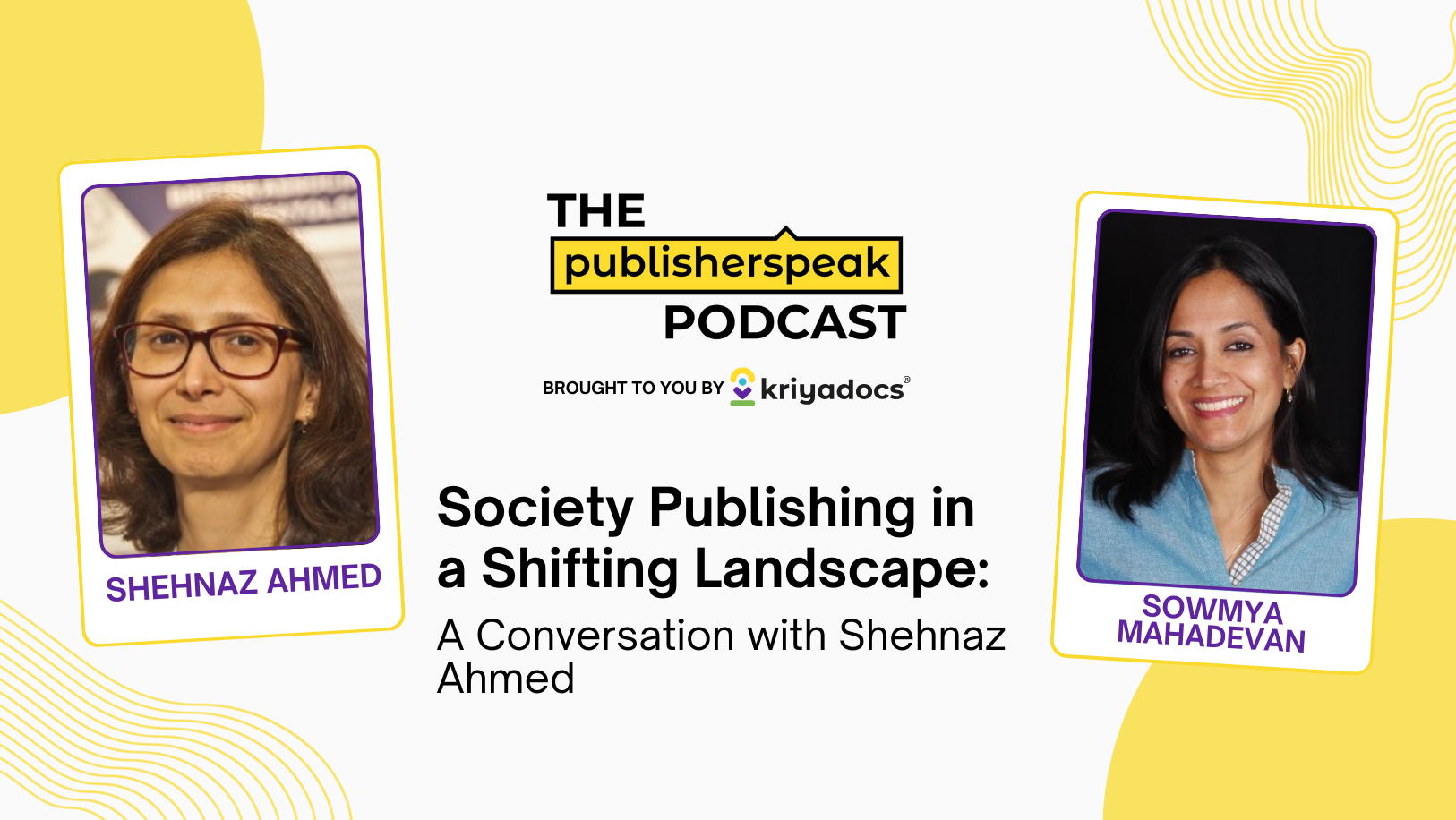
Host Sowmya Mahadevan sits down with Shehnaz Ahmed, Director of Research and Publishing at the British Association of Dermatologists, for a timely conversation on how society publishers are navigating a rapidly shifting scholarly landscape.
Drawing on her experience leading publishing and research portfolios—and her work with ALPSP’s AI Special Interest Group—Shehnaz unpacks the real pressures facing society publishers today. From peer review fatigue and limited resources to evolving financial models and AI governance, the discussion explores what it takes to sustain trust, relevance, and impact. Whether you’re a society publisher, editor, researcher, or industry partner, this episode offers grounded insights into where scholarly publishing is headed—and how collaboration can shape what comes next.
Dive into the full conversation below or watch the episode here.
Full Conversation
Sowmya: Hi Shehnaz, it's so wonderful to have you on The Publisherspeak Podcast. Thank you so much for taking the time to be here with us today. I'm very excited to have this conversation with you today.
But before we get dive into all the topics about publishing, I want to hear about your journey within this wonderful world of publishing. Where did you get started? Why did you decide to build a career in publishing? And how do you, you know, what motivates you to continue to be a part of this wonderful community?
Shehnaz: Hi Sowmya, thank you so much for inviting me to be part of this innovation. It is really nice to be here and I'm quite humble that someone's out asked me about my career path because I've had one of these really interesting career trajectories. My background is actually mathematics and, but I've always been very passionate about books and reading, and I never set out my career to be a publisher or get into publishing. I think my original plan was something completely different and it didn't work out.
I was a young graduate roaming around in New Delhi at the Delhi Book Fair and I saw this sort of this advert over there and they said, you know, we'll teach you everything about publishing if you come and work with us. And I thought, actually someone's going to pay me, I'm going to teach me about publishing. So, that couldn't be a better opportunity. So I went to this stand, a nice break to them and there was this lovely lady called Dr. Vani Guru and she kind of persuaded me about it, and I had never heard what academic coefficient, didn't know anything about it. And she kind of talked me into kind of coming and having a work that small agency called Bioworld and it was run by two people called Dr. Bandana and another gentleman who is from Oxford University Press.
It was a small agency and they taught me everything I know about journal publishing. And I literally started from the grassroots level, you know, doing typesetting, production proofs, talking to clients, learning project management. So, it was very hands on and right from editing, technical editing, it was hard work because we were very small and I was also doing my masters at the same time as doing this and they were very flexible in allowing me to do this. I would say it was my clear defining moment. And I thought, oh, this is good fun.
I get to do academic work which I'd never, you know, I wasn't planning to do. So read about it, edit it, you know, have a chance to interact and have the opportunity to see what happens to a book from concept to final delivery. So, I think that was what really pushed me to publishing.
Sowmya: Fantastic. And you are today the Director of Research and Publishing at the British Association for Dermatologists. You're also in several ALPSP leadership roles. Tell us a little bit about what you do in your day job today.
Shehnaz: So, in the BAD, I wear two hats. I look after the research portfolio, and I also look after publishing. In terms of publishing, I do what a lot of us society leaders do, which is we look after the, we have a portfolio of three journals, we've done a few books and we kind of look after the business.
We work with our partner publisher Oxford University Press and also get kind of managing stakeholders. You have to manage your governance side of things, but you've also got to manage business side of things. And you are really the conduit between the publishing community and your community, which is the academics. So that's one side. And in terms of the research, we have a small portfolio, I would say, I say small, but we work with a couple of universities, we run real world, large observational studies.
One of my studies have been going for 18 years and they are big, big projects that really help improve look at safety of patients in psoriasis and atopic dermatitis. And we are now opening up three new registries in parallel for vitiligo, HS, which is a very painful disease. And the third one is Alicia. So, my day job is sometimes looking at contracts and things like that on research, looking at the finances, working with university partners, trying to problem solve and looking at talking to funders.
And on the other side in publishing, kind of looking at day to day, you know, what are the needs, what are the problems? What does team need for me? And yeah, on both sides, I've got two very good, fantastic teams. Yeah.
Sowmya: And I think looks like pretty exciting, but also quite a challenge, I'm suppose, I'm sure. Right. Managing a lot of responsibilities there. You know, you mentioned that it was a very sort of a accidental entry into publishing. You walked into a book fair and that's something that I've heard from a lot of my guests over here. It's like they by accident came into publishing but then decided to stay and build a career.
Over a period of time, has there been anything that was surprising or, you know, pleasantly surprising or shocking about the publishing world and about, you know, how you've spanned so many years over here?
Shehnaz: I think I would say that the most pleasantly surprising thing about publishing is how welcoming everybody is, as.
Sowmya: You alluded to earlier.
Shehnaz: And actually the fact that everyone's willing to teach you, you know, people are willing to learn. So, I think that was what really makes it interesting.
In publishing, everybody is willing to share and a lot of us work in small societies. There is a lot of generosity amongst the society people to share information, to learn from each other. And we are always, we have less resources because we're always conscious of how much revenue we generate and we know that it goes back to our societies to do other, all the other functions. So, one of our ethos is, you know, how do we make this last more, how do we make it work? And, and we're, and everybody's got the ethos of let's get started.
So, it doesn't matter what your call, at the end of the day, you are one of the team members. Doesn't matter what your title is, if it's required, I'll be tomorrow rolling up my sleeves and at the registration desk or raptor man, the front desk, I'll do that. And everybody does that. And we all, you know, that's sort of given that's the nature. I mean in our organization, but also in publishing, I would say that is the nature. Everybody's quite, you know, willing to roll these leads up and get stuck in.
Sowmya: Yeah, I think that's certainly very true. There's a lot of very welcoming people, very warm people who are very eager and willing to share the knowledge.
Shehnaz: Right.
Sowmya: And I'm sure you coming from a society journal, this has been something that's very of, of a lot of value to you. But talk to us a little bit about what are some of the unique challenges or pressures that say a society journal has as opposed to a larger commercial publisher.
Shehnaz: So, I think we have fairly similar constraint. Well, I would say one of the biggest challenges we have in a small society publisher is that we're usually, we have small teams, and it can be both a pro and a con as well. So, it means that business as usual is always prioritized or over, you know, like those experimental things, those trials you want to do. So business of you as usual.
So that's hardwired indoor DNA. And I suppose I, in any business organization that is probably hardwired, it's how do you make that time to take a step, step out of it to do that. But one of the things we've done in my team is that every once a month we all come back together. We need it in person and we say, okay, we're not going to do business as usual today. Today we're going to pick up the journals and we're going to look at what development we've done in the last one month.
We're going to pick one project and we're going to keep tracking ourselves and goal ourselves accountable. So each, I've got three people and each of them is accountable for that one project, for that one journal. And then as a way, because we draw up all these strategic plans and we call journal development plans and then somehow in the business as usual it all falls away. But so, I said, okay, once a month we need, we don't do too many projects. And that's the other thing.
We were trying to be too ambitious and not able to achieve it. So, we said we'll take one project, doesn't matter how much it takes how long it takes. We just have to keep showing up and keep that momentum going and it helps with accountability. So little innocent is better than some of the other challenges. I think all of us are getting ever increasing number of papers, the number of reviewers are going down.
I mean the current reviewer peer review model is, is at breaking point. I would say we're all feeling the financial pressures from funders, like budgets are being cut. You know, for example, NIH has a consultation armed about capping open access fees. So, the model needs to be rethought. And I think one of the other things that I would say society publishers, and at least us, we're not very good at is we're not very good at talking directly to funders and librarians, university, we kind of take a backseat and sort of rely on our bigger publishers, say, okay, you're talking to the libraries and subscribers. So, I think, I think that rule has changed. I think we need to be doing a lot more profile revancing so that people know who we are and what we do as small charities. Otherwise, you're just a big number in a big portfolio. And, you know, how do you count? You demonstrate beyond quantity, how do you demonstrate your value to the community, to the wider context?
Sowmya: Yeah, that is one and one of the topics that came up at the Publisherspeak UK, which, you know, was very nice of you to come and participate there as a chair of one of the sessions, as a panelist in one of the sessions as well. But yeah, we did have a lot of discussions about the value that publishers bring to the table and are we doing a good enough job of communicating that to the authors and sort of looking so, yeah, so I think it's certainly a very relevant topic in today's world. And as, especially as a society journal though, that's. That, you know, that's something that I think a lot of the society journals are thinking about when you're operating under constraints and things like that.
But I also thought you had a very valuable business lesson or a leadership lesson that you were just talking about, which is the Power of One. I don't know if you've read that book. There is a wonderful book called the Power of One, which actually talks about, you know, doing that one thing, or I think it's called one thing.
It is actually a really nice, interesting management principle, but you just alluded to that, so I thought I would make that reference. But where it says, you know, pick one thing, do that, then go to the next thing, do that and do that. Right. Sometimes we want to do too many things at the same time and fail. So that's a very important, valuable business lesson that I learned from you today.
But taking on from what you said about the peer review aspect, right. You lead the ALPSP peer review fundamentals course and I think your society bad has also conducted in person workshops to train the next generation of peer reviewers. And you actually spoke about how the number of available peer reviewers is going down. So, talk to us a little bit more about some of these initiatives and what do you think publishers could do or societies could do to, to cultivate this pool of peer reviewers? Are we doing a good enough job? What are your thoughts on that?
Shehnaz: So, I think it depends on the day you ask me. And if your question is, are we doing a good enough job? I, and I think, and I am, I'm sort of a self critical person. So, with that caveat, I would say we're not doing enough.
We are not doing enough as much as we should. I think reviewers are very undervalued by us. I think we need to do more, which is why we've kind of. I teach the fundamentals of peer review courses because I'm very passionate about peer review and the value that it gives. I think the whole premise of academic publishing is trust.
We are built on trust. This whole system exists because of the reviewers who give so much of their time to review books, articles, journals, you know, and, and it's, and when I be talking to, young academics coming through the pipeline. And this is why we did the in person one because we used to do them remote, you interact with them. And they often say that, oh, we are just, you know, we are daunted by stunting, taking the first step because they think, oh, that paper is written by, you know, Albert, chief investigator who was a leading ad, say for example, he's a leading person in atopic dilatates. How can I review hints and research?
You know, I'm just a small resident who just starting off my journey. And we all say to them it's like, hey, first of all, it's about, like you said, the power of one taking that first step. Don't be daunted. And it's a very important skill of medical education. You've got to develop critical appraisal skills and you won't get to do it if you don't do it.
And often they'll say once we've done one paper, they kind of build that confidence. So that confidence comes and this course that we teach, that we do at the bat, hands on, actually gives them that confidence because they are literally talking through a paper with a group of, you know, in one senior editor leads about four or five people. They kind of ash it out together. It's like a journal club almost. And that they come away with that confidence.
Sowmya: That's what I think.
Shehnaz: That's all they need to say, yeah, actually I can do it. It's not as big a deal as I think it is. And I think it's about breaking down this sort of, this system of thinking that a peer review can only be done by zero senior academic. Yes, it can. Yes it, you know, but the senior academics don't have time. It's almost our obligation to start training and building up this next pool of reviewers who really want to do. They really want to do it.
They are hungry to do this skill and learn it. And there are some and they have a lovely, lovely odontologist called Professor Celia Moss who once said she's retired now, but she once said to me, she said, you know, you must use the gray army. And when she says the grey army, she's people who recite. She said, they want to teach, they want to be involved. So, you're forgetting them.
And then we are forgetting the people who are coming up. I was so busy piling on the people who are so invested doing the research who don't have time. So, we need to kind of use them to teach or mentor the Jungiana people and then bridge that gap. And you know, and the more care of you you do, the better you become as a water, the better you become as a researcher. So, I think it's kind of hearting and it's.
I think received wisdom. There is a lot to be learned and said about received wisdom. So I'm hoping this, the AD course will do that. The fundamentals appear to view that we do through ALPSP that is more about the operational side. So, how do we in society journals and a lot of us who join society channels often don't know what it is.
How do you. What are the types of models? How do you find efficiencies in these systems? And again, it's like looking for west duplication. Can I change little step and again that little in small change can go a big way.
Sowmya: I think that's a very interesting initiative that you guys run over there. But I see your point as well is that you know, we've been talking a lot about not finding enough peer reviewers and all of that stuff, but this building a community and actually nourishing and encouraging that community by actually teaching how to do peer review. I suppose that's not something that's very popular and it's not done in a very concerted manner to actually grow the school of publishers. And I think the grey army teaching the Gen Z or whatever you want to call it, I think is a very interesting model and I hope more publishers, more society publishers adopt it. But yeah, I think that's a very, very interesting takeaway.
And I think the point today is as well with AI, obviously we need to talk about AI in every podcast, but with AI, the volume of papers, and maybe it's because of AI or it's because of something else, but you know, papers are probably the volume of papers go up, but then, you know, but maybe, you know, there's this, this question in everybody's heads about now, Will, how do you find trust? What if, what if the paper was written by AI and all of that stuff? What are your takes on like AI coming into publishing and what are the challenges that you see or maybe even the opportunities that you see with AI coming?
Shehnaz: That's a big question and a very difficult question to ask science. All our minds is AI and it's trust is so inbuilt into the system. If that trust breaks down, I think it's going to be a real existential crisis for our community. So, I think trust is important. And I think I always say to my team that given the day of the week, I will sit on one end of the spectrum, on AI at the other end of the spectrum. And I think there are both opportunities and challenges, but it's how we as a community manage that. I think in terms of if I talk more about opportunities and say yes, I think AI could be a really good level player.
So, you could. Scientists who fall in English is not a first language could actually be a really. It would help them generate papers that could be, you know, could be. And I did, we did a study, this is years ago with I think about 3, 400 peer reviewers asking them what was the main reason that they were rejecting papers. And I was actually quite shocked to find one of the top reasons that's because of language, because they didn't think the language was good enough. And I thought, well, that's not right. That's bias, first of all. So, AI could be a playing field, but as long as there is gene diligence and checking.
Because, you know, AIs LLMs are based on predictions and on sort of average. So, using law of averages. So basically, if that one word has been used too many times, is it actually helping you or is it dumbing down your article too much? So again, there's an opportunity, there's the threat, there's an opportunity that maybe LLMs get better at translating. And that's something that, you know, all journals always say, oh, we want to translate, but translation costs are huge if you do it properly.
But with translation comes validation. So, if you can have translation and a human validation and is sparse and it's not that expensive, then maybe more journals could be publishing in multiple languages and then your reach of research is far greater.
Sowmya: Right.
Shehnaz: So that's an opportunity.
Sowmya: And you could also perhaps find peer reviewers in other languages if English could be translated into a native language and things like that.
So yeah, it certainly opens up a lot of possibilities. There are obviously also concerns governance, governance issues and things like that. And is there anything that you are doing to come up with an AI policy or how do you deal with this right now? Because I think, you know, six months back we were talking about should AI be allowed or not allowed. But I don't think that's even a question anymore.
All of us are using ChatGPT or whatever LLMs that you have for whatever purpose. Right. Whether it's creating a PowerPoint or whatever it is. So, it's no longer a question of should it be allowed or not. I think that question has flown away already. So, is there anything that you are doing at your society?
Shehnaz: Yeah, so we have just returned, we just published on our journal's website the sort of AI policy that we have, both for authors and for reviewers. So, we are saying that if you're going to use it, declare it. First of all, you know, I think it's very important that we are open and transparent about how we're using it. I would say the one thing we're saying is don't use for creating figures because of, we don't know how this copyright breaches can take place.
So that's one thing we're saying don't do at the moment. Again, this will evolve as the industry evolves. So, we don't, we are hoping, because I've been getting a lot of calls from some of the researchers saying, you know, hey, I wanted to publish my paper, but this is how I'm using AI. Is that an acceptable use by your journal. So, we publish the guidelines at the moment, we follow what Coke recommends as well.
We are not allowing AI for the use of review, peer review because it is unpublished continent, it's confidential material. So, at the moment we are saying we don't think it's allowable. And I think this is a very gray area because you get publishers experimenting different ways. Some are saying it's okay as long as you're only checking the language. So I would say that if you're writing a review and then you kind of put it ChatGPT and say Kojikis, summarize it rightly because your English isn't your first language, then maybe yes, as long as you do not put the paper into the LLM, ask it to review for you because then you're not using your brains, you're not doing critical thinking.
And the whole point and the whole premise of peer review is it is your peer, the machine is not your peer, the machine will have access. So, I think we do need to develop some frameworks and how, if you're going to integrate AI into interpering, we are going to have to say this machine can rules but these are the limitations because these are the databases it has access to. And so then the reviewer would say okay, okay, so then maybe it's missed that one paper that I've read in somewhere else or whatever. And again like humans, machines, humans, it'll have biases. I don't.
We are not experimenting with AI purism because we, I don't know if there are others who may be and I'm sure there are people who are experimenting. One of the things we've done with AI is we've launched AI podcasts just recently and we've worked with 67 bricks and that tool generates podcasts quite quickly but it's only using open access content at the moment. So, we'll see. I think we're doing it slowly slowly.
Sowmya: Lots of opportunities, lots of challenges, will be interesting to see how things shape up. And I'm sure that's true for all industries. It's not just for publishing. Right. So, as technologies evolve. Very interesting to see how the world changes with, with several of these technologies coming in.
But I think yes, publishers also need to evolve with the changing time as, as a society publisher, I think collaboration you mentioned, you know, like you, you, you have a lot of friends within the industry. So, what are some of the ways in which you collaborate with other societies? Or is that something that I know you're a member of ALPSP and obviously all of the other societies. But is there other things that you do to kind of keep each other updated about how's it going on? How do you find the time first of all to collaborate and what are the avenues?
Shehnaz: So, I'm part of something known as SocPc which is, and it's a really fantastic forum. It's for people like us society publishers who are either partners or self publish. And that's a brilliant forum, I would say. And there's a lot of shared learning. So, it's like an online forum every now and I will meet but most of the times like oh, somebody says I could have put this question that I and a lot of us work in small silos.
We don't have access to big resources. I don't have a clinic who just call and say oh, I don't want you to stop here. So, I can put my. So, that group is my sort of go to group. And it's been amazing. I think I joined it back in 2020 and it's like my lifesaver because if there's any question somebody go and pop that somebody into amongst the 200 publishers or people's societies or they will have an answer. So that's really one of the places we collaborate. But in terms of collaboration within the society, one of my colleagues does is, he works, he's worked with BSR which is another rheumatology-affiliated societies and they've, we've published a living guidelines with them. So, you know, you kind of expand reach.
So that's one sort of way of collaboration. But in research we've done lots of collaborations with the Skin Cancer Registry database, and we've made for the first time with the bat odontologists and the Skin Cancer Registry, we made the skin percussion data publicly available for the first time. So, it's got a, it's part of a bigger project called the get to Dao project which is being led by NDRS. So, those kind of collaborations and I think there is. You talked about time.
I don't think any of us is time. I think you have to make the time and it's how important it is to make the time. I think what societies need to get better at is we need to get better at sharing resources and getting. And so, if the ally and just even the example rheumatology, inflammatory diseases and dermatology sort of overlap, you know could there be synergies. And this is where we could say, okay, let's work together on a project and experiment. So, then we're sharing risks and we're sharing resources and cost and time and people.
Sowmya: Yeah, no ability. I think, I think like you've been mentioning before, this is such a good ecosystem where there's a lot of collaboration, but from what I'm hearing there could be more structured collaboration as well, perhaps amongst these sort of like related fields that will benefit. Yeah, so that's quite interesting.
Looking five years down the line, where do you see society publishers going? Like, what do you, what do you, I mean. If you gaze into the crystal ball with so many things going on right now, what do you see five years down the line? What are you most excited about or what are you most worried about? What are you, you know, looking forward to? In the world of society publishing especially?
Shehnaz: I think, I would say in the next five years the financial pressure on us are going to be even more acute. I think we need to get, get grips with our financial models and say, you know, is this still fit for purpose? How are we going to work like this? AI is here, but I don't think we've really got to grips with the licensing behind it. You know, we're still using CC by, and I just wonder if that's the wrong.
I am sure there are a lot of my colleagues who will all disagree with me. You know, is that when you pay for CC by you make it free available, but your LLM machine, you can kind of scrape it, use it. They then use that content which you have, or your author have this thing and then they charge someone else because they're building on that foundation using that, scraping the content, but then they're charging the users or the Pro model, you know, the more developed. So, I think publishers and the industry in particular needs to get to grips with their licenses. I know that authors are always confused around which license to use.
So, we need to get better at talking to authors and researchers and explaining to them. They don't care which license, they just need to know this is a form I need to click. And we need to explain to funders that, you know, every time you put a mandate it has an impact on us and this is the impact on us. And that's constantly becoming more and more challenging for us. I think in five years time it's really hard.
But I hope that AI will actually help improve some of the efficiencies we have inefficiencies we have at the moment will make us more efficient in terms of ideal pre production stuff that we do post production that we do. Some of the, you know, I was just talking to my colleagues and saying, you know, they, some of one of my colleagues was saying she's spending a lot of time responding back to emails and I was saying, oh, you know, the bikes have chat bots. And I said is there a way we could customize some basic questions that don't need a human being? You can check it, but you don't need to be doing some of those basic question goals like oh, how much was the APC that time? Could it be used to utilize somewhere else? And it takes a couple of minutes but still all incremental.
Sowmya: Yeah. There's like, like you said, there are opportunities that come up for with especially with AI to recognize some of those efficiencies.
Shehnaz: Yeah. And I think maybe in five years time will get better at coming out of our silos and especially smaller societies like us who have three journals, full journals and we'll maybe decide to become a collective. We'll become better at collaborating across disciplines, which is what the governments are also wanting in interdisciplinary work.
Sowmya: Shehnaz, it was wonderful having you today on The Publisherspeak Podcast. Thank you so much for joining us. Before we say goodbye, is there anything that you would like to share with our listeners? Any recommendation or an insight here?
Shehnaz: Thanks, Sowmya for having me. It's been a pleasure to talk to you.
I would say that never underestimate the soft power of a human being and continue to collaborate. Be kind but also be bold and experiment. Maybe we need to try and break some of the old conventions and test the system, see what happens, and yeah, that's it from me.
Sowmya: Absolutely. I think don't be afraid of the machines and bring out the magic in you. I think that's. Those are some wonderful words to part to close our podcast today. Thank you so much once again for joining us. It was wonderful chatting with you. Bye.
Explore The Publisherspeak Podcast on Spotify here.