.png)

.svg)
.svg)
.svg)
.png)


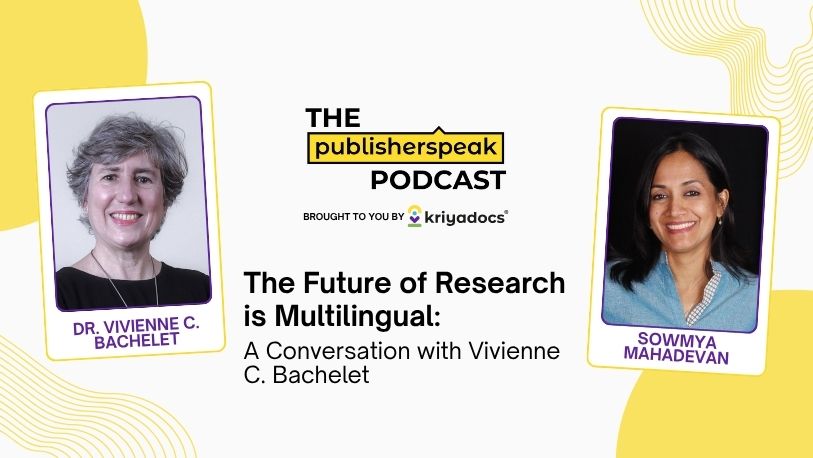


About The Publisherspeak Podcast
Real stories. Honest reflections. Conversations about leadership, change, and the work that shapes our world.
Hosted by Sowmya Mahadevan, Chief Orchestrator at Kriyadocs, The Publisherspeak Podcast features interviews with people making meaningful moves—inside and outside the world of scholarly publishing. From academic leaders and publishing professionals to coaches and change-makers, each episode goes beyond job titles to explore personal journeys and the mindsets behind impactful work.
In this episode
Host Sowmya sits down with Dr. Vivienne C. Bachelet—clinician, professor, Founder and Editor-in-Chief of the bilingual medical journal Medwave. Vivienne has spent her career bridging worlds: between medicine and publishing, between English and Spanish, and between traditional practices and tech-driven innovations.
We explore her journey from clinician to Editor-in-Chief and how Medwave has pioneered bilingual publishing. Vivienne also shares insights on where she sees the next frontier of publishing.
Dive into the full conversation below or watch the episode here.
Full Conversation
Sowmya: Hi Vivienne, it's wonderful to have you on The Publisherspeak Podcast. Thank you so much for joining us here today. You are such an accomplished personality. You've worn so many different hats. But for our audience, tell us a little bit, what do you do, Vivienne?
Vivienne: Right now, I'm mainly an academic. I'm a full professor at the University of Santiago of Chile and I say that's my main activity because it's what pays my salary. So, I earn my living as an academic and I'm very happy there.
I'm also editor in chief of Medwave, which is a general medical journal that I founded in the year 2000. The company, actually the publishing company and then our first issue came out in January of 2001. So as an academic I do research, and I do peer review for other journals, and I teach evidence-based medicine. I have my lines of research, and I try to take care of myself so that I have a long and fruitful life.
Sowmya: That's wonderful. So, you spoke a little bit about Medwave. That's the journal that you founded as an academic. What led you to starting a journal on your own? I know you've published with several other journals, several publishers. And what motivated you to start the Medwave Journal? And it's based in Chile. You publish both in Spanish and in English. So, tell us a little bit about Medwave’s history.
Vivienne: Yes, it's a bilingual journal and it's indexed, fully, peer reviewed, and it has its impact factor and stuff like that, but it wasn't always like that. So when I founded it, in the year 2000, I was coming up with this idea actually the end of the 90s, really I started thinking about the need for Chile to have a continuing medical education that would be appropriate for our geography and also for our living conditions and for our like per capita and things like that. So, Chile, as you probably know, is a very long, country. It has a whole bunch of different climates, and we have a very strong public health system. And one of its strengths is the fact that medical graduates, doctors, junior doctors, can be posted to very, rural areas of Chile where there was barely at the time an Internet connection. There would be one for the town.
Now all of Chile has Internet, but back then it was a bit more precarious. And once these junior doctors go off to stay like for four to six years, seen to very poor populations and they needed to still have access to continuing medical education and not have their training outdated, by the time they got back to do their specialization. All of this paid for by the Ministry of Health. So that was like something that I was seeing, our geography. On the other hand, I was very much connected to all of the technological advances that were happening during the 90s, so I was an early adopter of email and things like that.
So, I was seeing very strongly what the potential was. Remember that 2001 was the dot com boom and bust, you all remember that? Boom and bust. So, I founded my company as an online company practically and before even plus came around doing their only online thing. So, I said, let's bring together, Internet, with our geography and with the continuing medical education needs of our junior and overall, physicians, practicing physicians in the country.
So, I said let's do something like that will bring, updated content to these practitioners pretty much in real time. So, we did conference coverage and clinical meetings coverage, and we did edited content and we started with our first issue in the year 2001. So that's volume one. And just by chance I envisioned then to set it up as a journal with a journal structure, which was very forward looking because 10 years later in 2010, I made the decision to transform this resource filled website, with a journal structure into a fully peer reviewed journal with original articles.
Sowmya: That's fantastic. And I think there's a lot of importance that a regionally focused journal plays. From what I'm hearing in continuing medical education, is that a trend that you're seeing across the global South? Because there is this, I think across the global south that is the motivation to publish in the top journals. But increasingly we are also seeing regionally focused journals that are coming up. So, is that a trend that you've seen increase in Chile?
Are there more medical journals? Are more similar types of Medwave type journals? And what is your take on the need to have perhaps regionally focused journals?
Vivienne: I have not seen an increase in the number of journals. I've seen some long-standing journals change their name and try to partner up to make it more robust.
But what we see in the region is university presses that have a variety of academic and scholarly journals of different disciplines. And that is very strong in Latin America, especially with, I'd say maybe only with a state-owned university. So, all the way from Mexico through Brazil and Chile, from what I know there are a lot of strong university presses. Having said that, they are still under financed, under resourced, so their standards are lagging a bit behind. Which takes us to when I was founding Medwave, there were other forward-looking people also based in Brazil from the government sector who envisioned setting up a sort of a publishing opportunity for society journals.
And that's called Cielo. And probably everybody knows of Cielo and then there was Cielo Africa and this and that. So, it all started in Latin America. And Cielo was a big thrust to all these small independent or society based or university-based journals to jumpstart their technologization, so to speak, to be online, to have a presence online. They only had the print versions of their journals.
And regrettably what I see is that Cielo is lagging in, many features that they should have revamped by now. And so basically, I would say that our academic publishing ecosystem in Latin America got stuck. That's my view.
Sowmya: You adopted technology early on, and I think you had the foresight to make Medwave an online only journal. And I think technology plays a huge role in making sure that science reach a wider community.
Right, and I think you're also talking about how certain things might not necessarily make the movement and it is not adopting technology in the right way as well. Why do you see some practical opportunities for say technology to improve the quality the read of the publishing ecosystem as such? And what are some of the trends that you've been following that you are eager, and you're interested in?
Vivienne: I have not seen many important technological uptakes in my region and that's one of the shortcomings that I think we're facing here.
I think there's a big gap between what could be done with not many resources and what is being done. So, I think, we have so many needs in our region as well as in other regions of the world that what we devote to science, including dissemination of science, is really a minor part of our GDP. We're way under the WHO recommendations for health, gross domestic product investment. So we should be spending much more in all of our countries and also in Chile, which is one of the more stable countries of our, if I may say so, I think that the lack of space, fiscal space, to actually jumpstart a full-fledged ecosystem here is real in Chile. And I don't know about other countries, but we send a lot of our young brains off to Europe and to the United States, more to Europe to train and to do math master's degrees, to do PhDs.
And they do all that state funded, with Ministry of Science funds, many of them don't come back to our countries and some of them do and then they stagnate. So, when you see a country investing below 0.4 GDP points in research and development, you realize that, and that's more or less the average of the region, that there is no space for the publishing industry to thrive, the scholarly, academic, kind of publishing industry. So that's one of the reasons why we are also stagnating lack of investment on behalf of our governments to put pressure on societies and create opportunities. Cielo was an opportunity.
So, we need another more modern and tuned to the, to contemporary times kind of CLO program to provide this dissemination of science, we also need to increase the standards of the quality of science that is being conducted in our region. And that has a lot of many different angles to it.
Sowmya: No, absolutely. I think it starts with the research that is being conducted to the kind of findings and kind of output that is coming out of the system. But have you seen like larger publishers, for instance, start regionally focused journals and is that something that has happened in Chile or did you see an opportunity for things like that at all?
Vivienne: Well, what I've seen, and I've told my good friends from the Lancet what I've seen more what I would call colonization of opportunities here in Latin America. Specifically, many different big journals, especially medical journals, have started their Latin American version, or Global Health Latin America, whatever. I don't even know if that name exists, but I'm just giving it as an example. Right. So, the Lancet has one and BMJ, I think, has another one.
I'm not too sure, but it has happened, and I think that's very detrimental to the efforts that we are conducting in the region to increase our own standards. So, it's not just having our academics, our scientists, our researchers publish in top journals, but also having our local journals receive that kind of publication of results that will foster a more direct conversation with locally pertinent themes and needs that address our local needs. And while the Lancet and others can provide an opportunity for those researchers, I think we should always partner with local journals and with local instances to do a technological transfer and not just sort of like hoover out our best and brightest into first world and global north platforms.
Sowmya: Fair enough. No, that's an important, and I think you're talking about bridging that sort of a research gap that is existing. And journals can play an important role in making sure that the entire region is more scientifically oriented, more research oriented, more stating the research, findings oriented. So, it's not just about doing the research, it's also about publishing it and making sure that it reaches a wider community. Totally fantastic point there. Now you've worn multiple hats.
You've been a clinician, a professor, an editor, an author and a founder of a journal, and an academic. So, tell me which one is a favourite hat that you like wearing? Or is it a combination of all of this, which has been your most rewarding, enriching experience? Or I'm sure you're going to say all of those, but I was just curious about what has shaped you, your thought process is here.
Vivienne: I was a clinician for a very short while, just a few years way back then, and I think it shaped me enormously. But I couldn't do it for whatever reasons, doesn't matter now, but for whatever reasons, I get very stressed out, if I make mistakes with patients. So that drove me out of being a clinician. And then time passed, and I did my master's in clinical epidemiology. But of the hats that I wear, I think the academic hat is the one that by far suits me best.
It is an incredible space to be in. There are awesome colleagues. I'm lucky to be also on an interdisciplinary campus. So, my university is a medium sized unit. It's one of the top universities in Chile. Not the toppest, but one of the top ones. And so, all the different faculties are on one site. It's a big, site, but it's one single site. And that makes it really incredible. And I love serving in the university.
I love giving back, you know, it's so the academic world, when you are actually tenured, as I am, gives you freedom, gives you space to create. You do research, you peer review, you author your articles, you teach, you create your own lines of research, but you're also in tune to the needs of the country. Because my university is and so we're always catering to the needs of the country and the region. You articulate your research projects with others; you can do interdisciplinary things.
I mean, it's just fascinating and being in contact with young people constantly. Like, we're now starting the first year, it's the initial year of a minor in medical research in the School of Medicine for Medical students. And we've had a fantastic reception in first year students. So, over a third of that cohort is registering as we speak in this minor to do research. And that's just incredible.
So I'd say that the one that gratifies me most is being an academic. But without a doubt, my passage through the private sector, when I had my companies, and I still have the publishing company, of course, that was very important in giving me the experience of having to create value. And you must know what I'm saying, right? So, to create value and sustain families based on your discipline, your expertise, your leadership, and the opportunities that you create for your people and having safe workplaces, not easy at all. And I think I would not go back, I would not Want to have to be on in the private sector exclusively. But it has attributes to what I'm doing now. Strongly. It gave me a lot of professional insights that I carry over to my university work.
Sowmya: Yeah, no, absolutely. And I think you're at the forefront of like sort of getting people to disseminate knowledge and science. So, as an academician and as somebody who's also wearing a publishing hat and been very close to publishing, do you foster that sense of publishing amongst your students? Do you teach them how to write research papers? Is that part of you.
Vivienne: Yeah, exactly. That's exactly what we do. What I do, I love mentoring. I'm at a stage of my life where it gives me enormous satisfaction. And I joined the university at the end of 2016 and by 2019 we had already published our first research papers with students. And from then on, most of my publications, not all of them of course, but many of them are co-authored by my students year to year.
They may change. Some of them carry on, some of them are with us for a couple of years, then they go on and do their internship and then they just keep in touch. But that's all. But yes, and you know, and we make them write the papers, we overhaul them completely. Whatever they write, you know, a little bit will be carried over to the final paper but it's just pushing them to really think and, even know how to use AI. Right. So, we do admit that AI is part of our arsenal of tools that we use to write papers, to write grant proposals and whatever. So yes, I do work with young people continuously. I love that. It's one of the parts that I love most about my work.
Not so much teaching evidence-based medicine, which I also love, but working with the smaller groups in a Cambridge style kind of teaching with small groups of three professors, you know, teachers like my colleagues, my junior colleagues, but I'm also mentoring them. So, we would be like maybe with three, four, five students. And so that would be a research team working on a research project. It's just brilliant.
Sowmya: Now one of the conversations that keep coming up is relevance of publishing in today's world because with AI coming in and with generally a lot of information is more freely available with open access with preprints and things like that.
So, for a researcher, for an author, the need to actually publish with a journal, is that going down. Do authors really understand the value that publishing is bringing to the table. Are publishers doing enough to communicate the value that they're adding to this whole process? Now, what is your take on that? I mean, as somebody who's been on both sides as an author publishing with other journals as well as a person who's running your own journal as well, where do you see the relevance of publishing or the value that publishing is bringing to the dissemination of science? And where do you see that headed.
Vivienne: Publishing is essential to the scientific endeavor. I mean, there's no doubt about that. It all started back in the 17th century, and it will not stop. So, whoever thinks that we're going to go over to preprint platforms, that train has already left the station.
So maybe during COVID we're all about preprints, but it's not where it's going. Publishers do add value to the research papers in a very significant way. It's hard to quantify the value, but it's there, you know, and there's a lot, there has a lot been written about that. But what really drives the need to publish is something that I don't agree with. I'm very critical of which is the ranking systems that is very pervasive today in the university sphere.
So, all the major universities, the mid-tier universities, the lower-level universities, in this capitalistic oriented, even neoliberal kind of environment in which we're all in on a planetary level, means that we're all competing. And that's not good. It's not good for science, it's not good for human beings and it's not good for the younger generations, it's not good for the planet for many, reasons. So, I think one of the more negative aspects of the recent decades which came around in the 90s and 2000s, was the ranking system for universities. And that that only set in cement what was already happening before, which was the publish or parish culture.
Right. So having said that, I'm very critical of the publish or parish culture and I'm very critical of the impact factor, but I am also a very practical and pragmatic person. I belong to a university; I recognize the need for that university to stand out. I know that they want me to publish in high impact factor journals, and I will try to do my best to do that and to please them because I'm very happy where I'm working and we have a very nice working environment. And so, I'll try to do my best to help my university further their standing and status while at the same time always pointing out that this is a cycle in history and it might not be like this forever. Now it's like this. But we must always keep in mind that things could be better, should be better, and we should all be working to make things better. So better means, yes, publishing, but not publishing to compete, but publishing to put outside to others.
What my findings are, when I've done high quality research that is pertinent in my case to health needs of our populations. So, if we just keep ourselves close to humanistic values, that's going to be our North Star and we won't get lost.
We might do things that we're not happy with, so long as they don't, go directly against our values. Of course, I'm very much into research integrity, publication ethics, so I perfectly understand that, we have to do whatever we do, publishing, writing our art, submitting, following certain rules and standards, and we have to be very careful with that. Do it right do it well. But don't think that that's the end of history. There can be other ways of creating value and advancing science. For the veterans of humanity.
Sowmya: I think that's a very powerful thought there and a very powerful statement that you're making. The whole purpose of publishing is advancement of science. And it's not this competition and this ranking that somehow, it's many times associated with. On that note, I think, this is like a great conversation that I've had with you. Are there any other final thoughts that you would like to share with our audience?
Vivienne: Today, I think just stressing the need for advancing multilingual publication is very important. We've done something with our platform in which we can do typesetting, production and peer review.
I do it bilingual Spanish and English and I think it's very important to underscore that while we try to go global with our findings, we must always keep in touch with what gives us purpose in life, which is our adjacent communities and the broader regions in which we are inserted in. And those regions don't necessarily speak the lingua franca of the day, which is English. And just a reminder that we're always just a small time point in history. There have been other times in which lingua franca were other languages, , either Latin or French or whatever.
Maybe it won't always be English. So how important it is to preserve our linguistic origins and maintain them. So, while we will communicate our findings to the world in whatever language the world is speaking in science today, we must also produce and generate and think from our own language. Like Spanish. Well, I'm bilingual, but in my country it's Spanish.
So, that people feel comfortable in what they're doing and how they're doing it. So, I just would ask publishers worldwide to fully consider promoting adamantly multilingual publishing platforms.
Sowmya: Absolutely. And I think with the kind of advancements we are seeing with AI, all of this is going to be super achievable today, whereas it must have been more of a technological hurdle. But I think, getting an AI system to translate so that people can better understand science into, in their own language is so much closer to us today than it has ever been in history.
So yeah, that's a great point and I think it's something that we all probably should look forward to with respect to how AI, how the new technologies are going to change the way, change the multilinguality of publishing. So, thank you so much, Vivienne. It was wonderful chatting with you.
A lot of very powerful messages from you and it is, wonderful to talk to somebody who is running a journal out of Chile, out of the global south, who has started it and has really transformed the way science is disseminated in your local region. Thank you so much for joining us here today on The Publisherspeak Podcast.
Vivienne: Thank you for having me.
Explore The Publisherspeak Podcast on Spotify here.